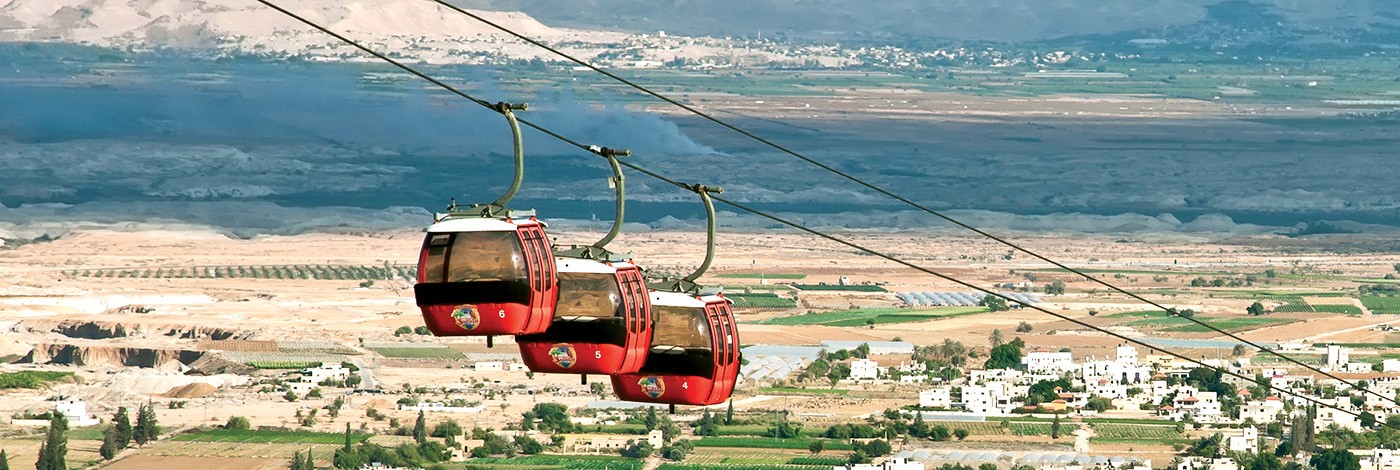
As the oldest continuously inhabited city globally, Jericho presents travelers with a unique history and dazzling sites. Dating back to more than 10,000 years, Jericho is famous for being the lowest city on earth, 258 meters below sea level. Its climate and below-sea-level location make it a favorite winter resort for visitors.
Jericho, meaning 'fragrant' in ancient Canaanite and Hebrew, is an oasis extending from the nearby Wadi Qelt in the Jordan River Valley. Jericho and its surroundings have become an agricultural area renowned for its citrus fruits, dates, and bananas because of its many springs and wells.
The city is located 30 km east of Jerusalem. It is 10 km away from the nearby Allenby Bridge, 90 km from Ben Gurion Airport, and 120 km from the Sheikh Hussein Bridge.
Top Tourist Attractions
- The Mount of Temptation. Perched high above a mountain is this Greek Orthodox monastery, an architectural wonder which hangs off a cliff. According to tradition, this is where Jesus spent 40 days battling Satan's temptations. The mountain itself offers visitors a spectacular view of the Jordan Valley. On the mountain's eastern slopes are a series of 40 caves that monks and hermits have inhabited since Christianity's early days.
- Ancient Jericho. Tell el-Sultan is considered to be the oldest and lowest town on earth. The ruins of this Neolithic settlement take the form of mud-brick round houses surrounded by a wall and a round tower, indicating the earliest preserved fortification system on earth.
- Hisham's Palace. An archeological park that houses the finest examples of Umayyad architecture in Palestine. It offers visitors a rich collection of magnificent well-preserved mosaics and decorative motifs, like the infamous 'tree of life mosaic.'
- The Sycamore Tree. Found near Jericho's city center, the sycamore-fig tree holds great symbolic significance to Christian pilgrims. According to tradition, Zacchaeus, a chief tax collector, climbed up the tree to see Christ while passing through on his way to Jerusalem. Jesus then called on Zacchaeus to descend from the tree, thus prompting his repentance.
- Wadi Qelt and St. George's Monastery. A remarkable natural wonder, Wadi Qelt is a valley with high sheer rock walls lying halfway between Jerusalem and Jericho. Its numerous fauna and flora prompted authorities to make it a natural preserve—Palestine's finest. Carved from the surrounding cliff perched above the valley is St. George's Monastery, a Greek Orthodox complex built between the 5th and 6th centuries AD. Wadi Qelt also cloisters what many believe to be the world's oldest synagogue.
- The Good Samaritan Inn. This old travelers' stop is a few kilometers southeast of Jerusalem. The site hosts a 16th century Ottoman post built as a haven for traveling caravans. Despite ages, tradition hasn't changed much as the place continues with its good hospitality: the site is host to a picturesque Bedouin tent where tourists are offered refreshments, as well as a souvenir shop.
- Prophet Moses. Nabi Musa is one of the most famous Islamic sites in Palestine. It is an Islamic shrine, built where many believe lay the burial site of the Prophet Moses. Over the years, the shrine has been enlarged to accommodate pilgrims and visitors alike and now comprises a colorful mosque with a towering minaret overlooking the impressive Jordan Valley.
- The Jordan River. Running a 251-kilometer course from the mountainous southwest of Syria to its final destination in the Dead Sea, The Jordan is without a doubt the most famous (and to many, the most sacred) bodies of water in the Middle East. From the time ancient Israelites crossed over into Palestine to the time Jesus was baptized, up to modern times, this Biblical river is a must-stop for pilgrims and visitors alike. Each year, thousands visit the site to be 'baptized' again in a solemn ceremony officiated by priests of various Christian denominations.
- The Dead Sea. This impressive body of water boasts the record for being the lowest point on earth, it is the deepest salt lake in the world, and it is the saltiest body of water on earth with a salinity that is almost ten times higher. Then that of the ocean! The Dead Sea's mineral-rich mud is renowned for having medicinal attributes that range from healing skin illnesses to chronic ailments such as arthritis. You can either enjoy an excellent soothing mud massage on its beaches, or you might as well bask under the sun while gently floating on the surface of the highly dense water. With all the restorative powers of its waters, the Dead Sea is a real-life giver!