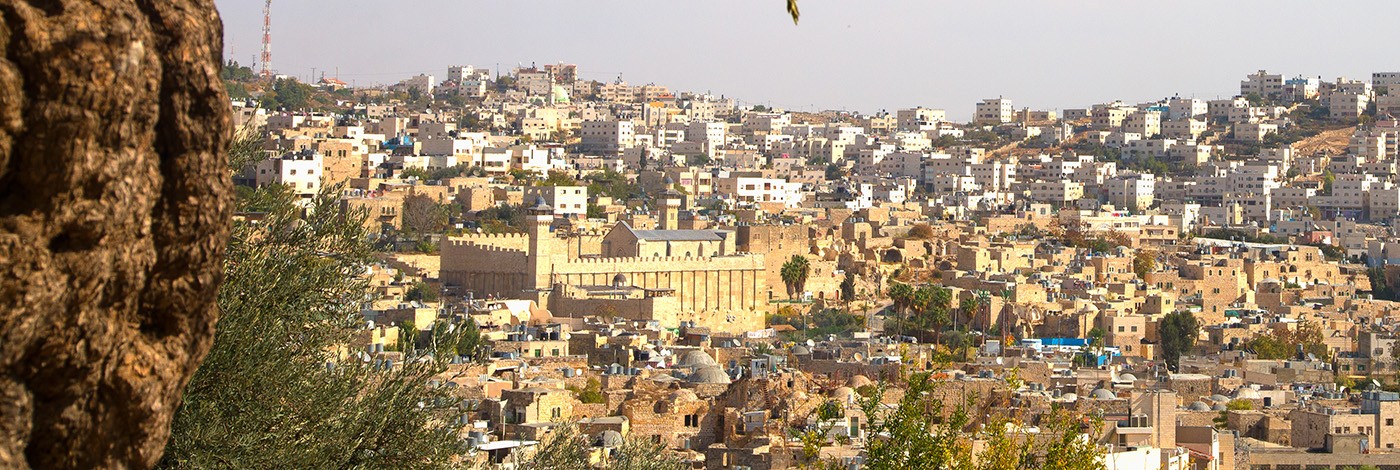
The largest city in the West Bank, al Khalil, or Hebron, is famous for being the industrial powerhouse of Palestine. In terms of history and religious significance, Hebron rises to the prominence of Bethlehem and Jerusalem as the city hosts the burial sites of Prophets Abraham, Isaac, and Jacob, thus making Hebron the fourth holiest place for Muslims a must-see for all pilgrims and visitors.
Its history, however, dates much further back than the time of Abraham: archaeologists claim that Hebron's old city (a smaller version of the famed one in Jerusalem) and its surroundings trace their origins as far back as the Early Bronze Age. The town then prospered in the 17th and 18th centuries BC. It then rose to become a royal Canaanite city. According to the Old Testament, King David came to rule his kingdom using Hebron as his capital for some seven years. As with most of Ancient Palestine, Hebron fell to the Romans, Byzantines, and later to the Early Arab Islamic conquests in the 7th century AD. It was one of the last cities to fall under the Arabs.
Walking the streets of Hebron's old city is an unforgettable experience, for much of its architecture reflects the preserved touches of the Mamluk period, and its local market, or souk, offers traditional hand-made products. However, Hebron's most famous landmark is the Cave of the Patriarchs, a mosque housing the tombs of 3 Prophets fundamental to the 3 Abrahamic faiths.
The city is located 30 km south of Jerusalem. It is 85 km from Allenby Bridge, 80 km from Ben Gurion Airport, and 210 km from the Sheikh Hussein Bridge.
Top Tourist Attractions
- The Cave of the Patriarchs | The Ibrahimi Mosque. Located at the center of the old city, it is an impressive structure dating back to the time of Saladin. Beneath the design is a series of underground chambers that, according to tradition, contain the tombs of the Patriarchs Abraham, Isaac, and Jacob and those of their wives.
- Oak of Ibrahim. This is this miraculous oak tree estimated to be some 5,000 years old! According to tradition, it marks the site where Abraham pitched his tent to host three angels sent by God. More interesting is the belief that bits of its trunk can bring good luck.
- Mamre. An ancient Canaanite cultic shrine is dating as far back as 2,600 BC. There is an ancient well-referred to as Abraham's Well, where three angles informed Abraham that his wife, Sarah, was to bear him a son—Jacob.
- Halhul. A town Located north of Hebron, it is home to an ancient underground tomb and is believed to be the burial site of prophets. It also offers visitors a most undisputed treasure, countless vineyards that yield to, what many attest, are the best grapes in Palestine.